
Can Biking Bring Us Together?
Proposing a Bridge Over the American Divide

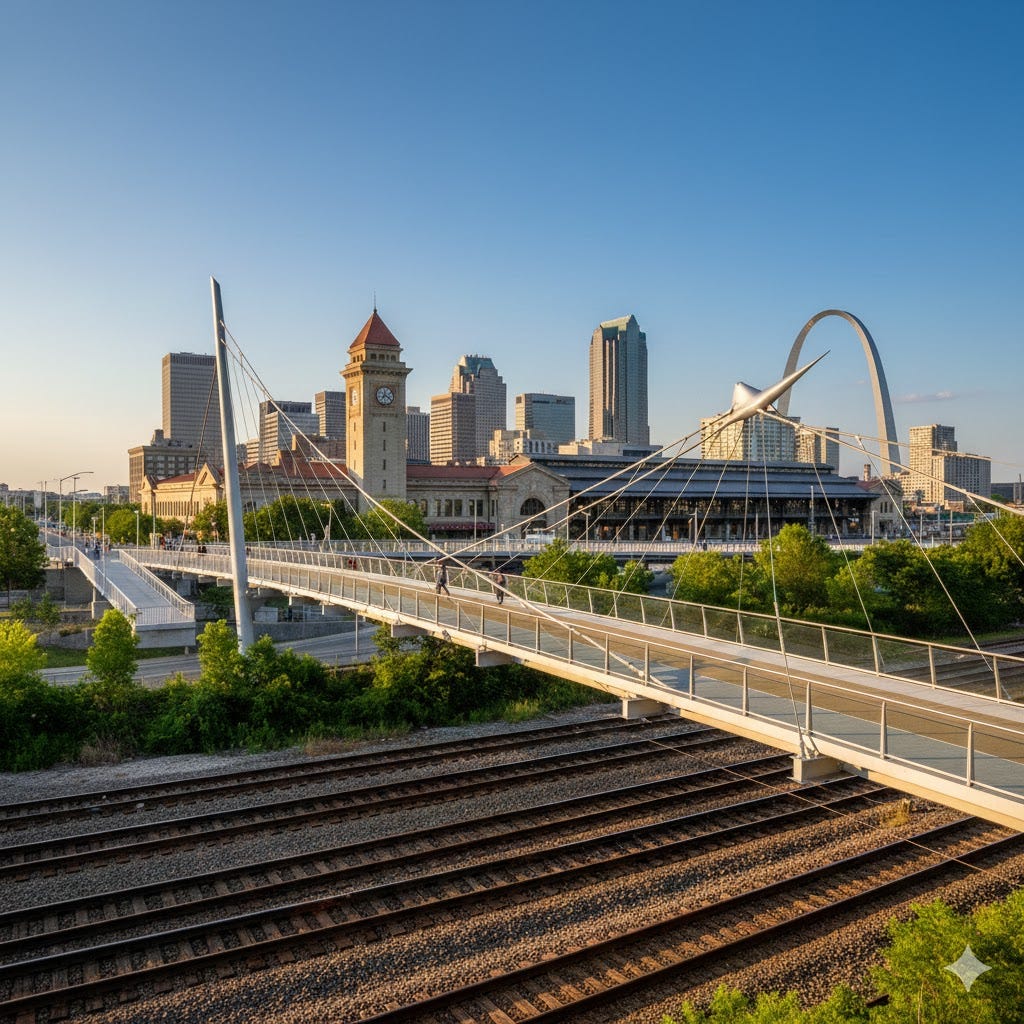
A rendering of the “path-uniting” bicycle bridge I imagine.
A great rift divides the country, and no one seems to know how to mend it. It is primarily political and cultural: “Blue” vs. Red.” But it can be parsed in other colors as well: “Black vs. White” or maybe “Lavender” vs. “Vanilla” (?). But however one divides up these divisions, they also seemed to be underlain by geography: urban areas tend to harbor one side of the divide, the outland the other.
The rift is much bewailed. America, we are told, has never been so polarized. But a passing glance at history shows that, except perhaps for a couple of short-lived and shallow hiatuses (the Era of Good Feelings [1815-1825] and the post-World War II boom) there has always been a rift. The alignments were different but the standoff remained. “The causes of factions,” said James Madison, “are sown in the nature of man.” Rather than try to ameliorate them, the venerable author of our nation’s Constitution, in fact, harnessed their antipathies to turn the very wheels of democracy: hence our system’s checks and balances and partisan affiliations. What holds us together is what tears us apart.
But can we take some of the edge off?
The city that surrounds me—St. Louis—furnishes an instructive opportunity. Our divisions might be starker than most. Sitting smack in the middle of the country, we straddle a bit of north, south, east and west. Black people, for the most part, live in the northern reaches and white people, more or less, in the southern (an odd inversion of their historical positions). Politically, blue people live in the eastern, more urban, parts and red in the western, more rural ones.
And thus it was supposedly ordained.
But I have an idea. As a white resident of St. Louis who gave up car ownership two decades ago—and who now navigates the city largely by bicycle—I was tooling along its historic, tree-lined streets when I realized something. Being one of very few cyclists about, it was hard for me not to think of the huge role played by the automobile in my isolation. The car has aggravated the Rift. Think of white flight. Think of Eisenhower’s adoption of the German Autobahn as a national defense measure, a.k.a., our Interstate Highway System which, in practice, might better be named the “Intrastate Migration System.”
If the car is the instrument of mutual estrangement, could the bicycle be the instrument of rapprochement? When I pass another cyclist on the street, I often nod my head or wave. When I’m careening at 65 miles per hour on a freeway, I’m just dodging missiles. When people leave their cars and enter a shared public space, they can interact as human beings rather than carriers of certain color-codes. Having visited Atlanta’s wildly popular Beltline and Indy’s urban bicycling network, I see one reason why both cities feel less divided than St. Louis.
To bring parity, we’d need to apply Eisenhower’s idea to bikeways.
St. Louis, to its credit, already boasts many bike trails and bike lanes. It’s just that they don’t connect, so it is hard to use them navigate the city as a whole. And they all come to the end of the line in one place: at an industrial corridor now running south of downtown, dividing North and South like a moat. (It actually sits on a filled-in waterway once known as Chouteau’s Pond). What if a bridge were built over this moat?
I floated the idea to my alderwoman, the mayor, and various bicycling advocacy groups. They liked it. But they all raised the same objection: the $15 million price tag.
Hmm. A study in Portland found that $15 million spent on a basic bikeway yielded $58 million in economic benefits. (That city’s entire bicycle network was cheaper than 1.1 miles of urban freeway). Another study, factoring in big-picture benefits like health, concluded that driving cars costs society 29 cents a mile while bicycling saves $1.61 a mile. If the math holds, this bridge would pay for itself, and then some.
What’s not to bike?
In St. Louis, the only logical spot for the bridge, around 22nd St. and Chouteau Ave., would connect two of our most vibrant neighborhoods. One of these is Lafayette Square, a gorgeous repository of restored French Second Empire mansions, as well as a foodie mecca. The other, Downtown West, hosts breathtaking Union Station, the St. Louis Aquarium, and the newly built St. Louis CITY SC soccer stadium, all close to the Cardinals’ home turf, Busch Stadium.
But besides creating one walkable, mega-neighborhood out of two now-car-locked ones, there is the crucial overarching effect: a crossroads for leg-powered transit from and to any direction. If bicycling is better than free, another boon would go to those on the north side, who have the least of all to spend: besides saving on gasoline or bus fare, study after study finds that people who commute by bike rather than car suffer drastically lowered chronic health problems and attendant financial hardships.
But after years of hobnobbing with powers-that-be, I still haven’t gotten my bridge idea off the ground. Is this a “bike dream?” Don’t highway engineers still call the shots? During the Trump administration, federal funding for bicycle trails was slashed while funding for highways wasn’t.
I did, however, find hope in one quarter: among highway engineers themselves. The Missouri Department of Transportation grasps the logic that its federal underwriter doesn’t. In the last decade or two, MODOT has undergone an internal cultural transformation. At one point wholly car-centric, it now envisions “complete streets”—thoroughfares that integrate the needs of motorists, bicyclists, pedestrians, shops, and residents. In doing so, it articulates something that James Madison had no words for, something like the common good. MODOT now aspires to carve out common (literal) ground.
I learned about MODOT’s change of priorities when my alderwoman asked me to take part in its “safety audit” of one of the most fatality-strewn thoroughfares of St. Louis, Gravois Avenue. This wide boulevard is another physical chasm that has long divided St. Louis neighborhoods. It cuts diagonally across the street grid, creating dozens of six-point intersections, culminating in a sort of raceway that gives drivers a green light for speeding. After canvassing the boulevard, my team agreed that this street was overdue for a narrowing. If the sentiment is borne out, what was once a roaring canyon of traffic will become a trickling creek, and the space liberated on each side will allow more room for sidewalk cafes, pedestrians—and enhanced bike lanes. These, in turn, will pave the way toward a bridge over our troubled waters.
It almost seems ordained.
I live in Columbia, MO and the bike routes here are one reason I took my job here. The reality is that when people can bike and walk more, they are less car dependent and this can free up money that is spent at local businesses. It is a win-win and unlike our highways which are built on debt, is an investment that holds up longer.
Chestnut Street here in West Philadelphia used to be a 3 lane speedway. A few years ago they cut it down to 2 car lanes and added a parking-protected bike lane (the bike lane is between the sidewalk and the parking lane on the north side of the street). They also put in nice concrete islands at the front and back of each block for pedestrians waiting to cross between the bike lane and the travel lanes.
It’s much safer, and while hardly Edenic, a much nicer space to be in than the wasteland feeling it used to give off. What’s more? Travel times by car are just as smooth. The lights are timed for traffic going about 30 mph. You sort of cruise on through. It’s better for everyone!